
Reading Ruminations
On my first reading project of 2026

The start of the year has been a busy one: events, birthdays, and lots of illnesses. I was, as a result, slightly delayed in completing my first reading project for the year, and subsequently delayed in writing about it. Still, I count it as a great success, and cherish the books I’ve read. Below you’ll find a smattering of reflections. I intend to formulate my next reading plan in the coming days.
Like Death by Guy de Maupassant
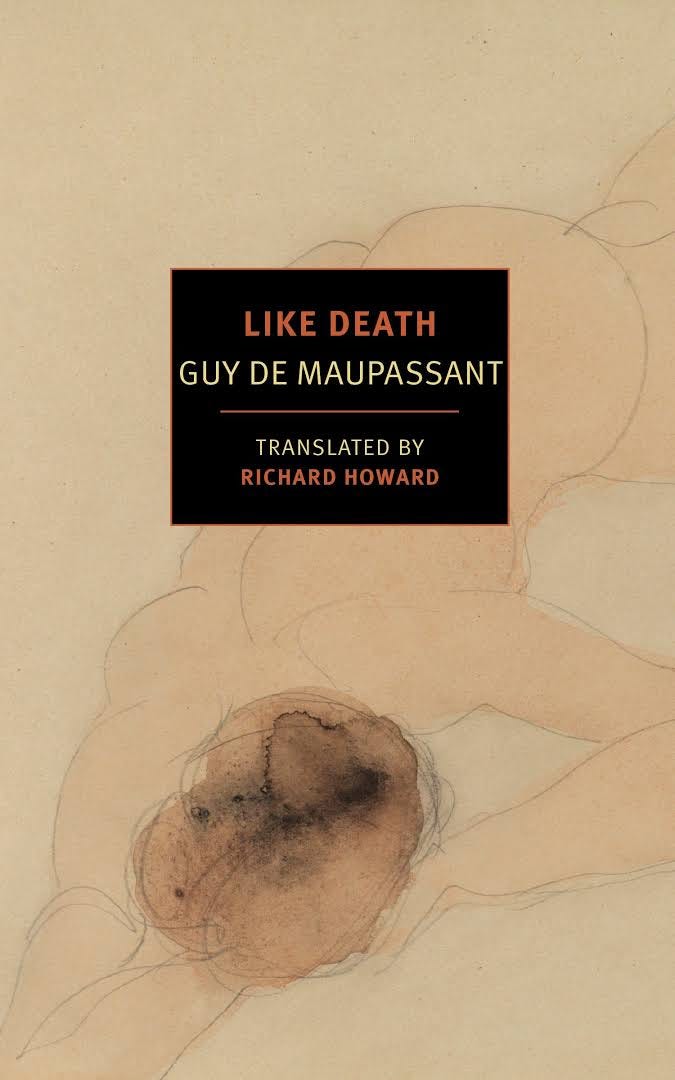
The novel follows the intertwining lives of painter Olivier Bertin and his muse and paramour, Anne, the Countess de Guilleroy. It is a story, among other things, about love, the way we force it on or cultivate it in others, and the often ironic consequences of these machinations. Running alongside this central river are other rivulets, bending or falling in different ways but heading in the same direction, about man’s place in society, the cultivation of an aristocratic ethic and life (and how empty this often is), and the many games we play to elevate and gratify ourselves. At the book’s core is an Augustinian inability to understand the motivations and inner lives of others: it is an impossibility, and the whole or most of the point of the novel.
On a formal level, aside from the masterful narration—the use of the unbidden flashback prompted by a sensory experience is an antecedent of Proust—and delicate yet intense psychological insights, what struck me was the use of contradictory clauses in a paradoxically additive way. The “or” clauses sometimes function, as we’d expect, like the pruning of a bouquet: the image of the flowers firmly set in our minds by the initial clause, but then a “let me just…” as he cuts an unwanted twig or shoot to perfect the shape and colour, the meaning. But other times the “or” is somehow additive: an alchemical process occurs whereby the meanings of the words combine into something more, and through this paradox we derive a greater approximation of the tawny truth. The first word or clause imprints, and the second is added on top, the “or” not entirely effacing the first, creating a thin palimpsest where both words mingle. This is without a doubt Conrad’s ephemeral halo, the “glow that brings out a haze.”
Monsieur Teste by Paul Valéry
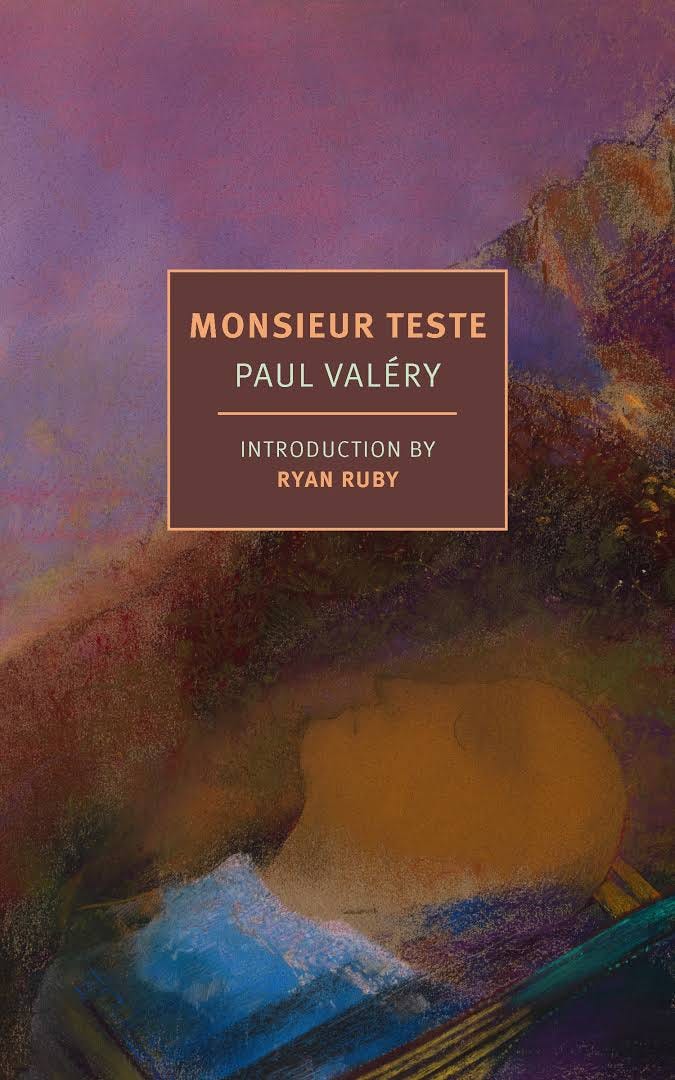
I wanted to love this book. Alas, while I enjoyed it, I think it is not as successful as Dostoevsky’s Notes from Underground, Camus’ The Outsider, or Kertész’s Liquidation (more on this below). To be fair to Valéry, as he himself said, the novella is both experimental in the extreme and originally in French; translation is already a fraught enterprise, and in this case it was possibly fatal. Perhaps, if I ever brush up on my French, I’ll give it another try.
The novella is broken into stylistically divergent parts: initially told from the perspective of a friend, then Teste’s wife, then journal entries by Teste and various aphorisms, then back to a friend’s perspective. Everyone in Teste’s life holds the man in high esteem, an eccentric sage or genius, and initially I thought… these people are delusional, perhaps swept up in the odd charisma of a cultic idol. But then you read Teste’s writings and there is indeed something of wisdom there, but it is sporadic and broken, and difficult to access. The idea, for example, of the impossibility of a complete and totalizing thought, because it would mean the end of life (what left would there be to think?), is fascinating, but so esoteric as to be meaningless.
Valéry writes that Teste is meant to be an experiment of man in extremis, and therefore an impossibility; he is something we might observe in a test tube and derive some knowledge from, but not something real. Fair enough. But where the same, I think, can be said of Dostoevsky, Camus, and Kertész, Valéry’s is so extreme that it’s akin to an exotic particle, a muon say, created under lab conditions and existing for a skant 2.2 microseconds before it obliterates itself. Which is to say, of limited use.
No Exit, The Flies, Dirty Hands, and The Respectful Prostitute by Jean-Paul Sartre
I wrote a long-form reflection on No Exit here.
The Flanders Road by Claude Simon
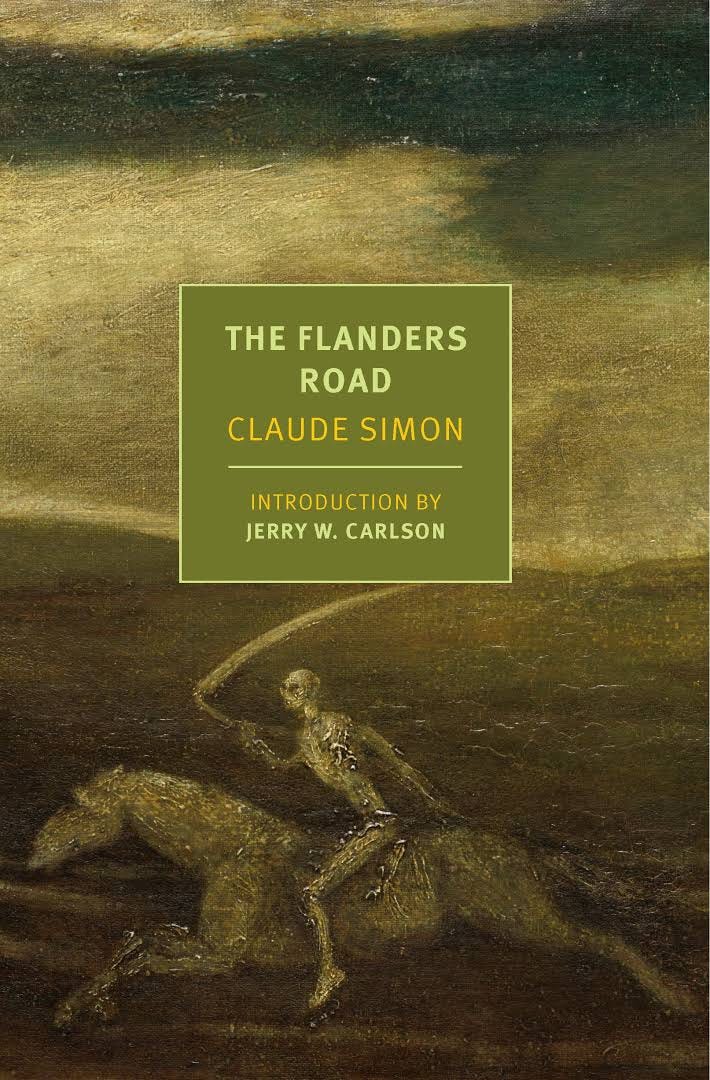
What a novel! This marks the first derailing of my reading plans, because Simon proved a (very enjoyable) slog. Almost every sentence is a run on, sometimes for half a page or more, and there are parentheticals within parentheticals, and quotations within quotations, such that I occasionally came upon a closing quotation mark having forgotten when the speech began. He’s just as loose with time, moving between four or five epochs in Georges’ life, and occasionally the transition is so subtle you don’t realize it for several lines, like an impeccably blended gradient. The novel strikes me as a fascinating play on Proustian revery and remembrances (and a fun connection to Maupassant), wherein the flashbacks act as a sort of internal allusion: it’s more than just a recollection or a reorganization of the fabula, as we seemingly exist within both/all of these moments simultaneously, and they are constantly acting upon each other.
This is part, more broadly, of the phenomenological quality of the work. There’s a plot—Georges’ survival after the tragic ambush, his search to discover Captain de Reixach’s motivations (again, unknowable! It is exceedingly gratifying to trace these themes across books and times), etc.—but it is secondary to sheer experience: how the horse decays into the ground; the look on Georges’ father’s face, or rather the reflection on his glasses, as he sits in the summerhouse in dusk’s growing darkness; the blobs of inky blackness that nonsensically obscure the small window in the cattle car, the twists and pressures of limbs above and below and between. He also, like Maupassant, contradicts and complicates his descriptions, opting for “or” and “or rather” and “better yet,” conveying multiple sometimes competing senses that somehow work together to convey an astonishingly full complexity rather than cancelling each other our or rendering something inane as one might expect (similar to Maupassant, though here with greater emphasis on confusion: it is paramount to Simon’s project that we do not fully understand, that things cannot be fully understood, but they can be groped at).
The effect is one of vertigo, as Simon himself puts it, quoted in Carlson’s masterful introduction to the book:
“The novelist today tries to make his way though a kind of fog; it isn’t really a question of irony, but one of vertigo: he just doesn’t know the answers. You are faced, as always, with the unknown, the unknowable.” (pg. viii)
But Simon doesn’t let us flounder completely. For example, on page 61, at the end of Part I of the novel, Simon miraculously weaves the temporal strands of the story together in a way that floored me. Such a possibility had totally eluded me! Around 50 pages later, Georges is having a conversation in a POW camp with two others, Iglesia and Blum, and Iglesia speaks and then Blum and back and forth until Blum responds but suddenly we learn in parentheses that it’s several months later and Iglesia is no longer with them (and yet the conversational exchange flows!). Simon eschews all the rules of time. Relatedly, he ignores the rules of syntax, too, and yet it still works; more than works, it knocks you over: it’s affecting, conveying as it does the hurly burly of drunkenness, the pellmell of a rout, the dizziness of infatuation, or simply the disorder of thought, memory. I felt like Borges reading Kafka’s Metamorphosis: wait, you’re allowed to write a story like this?
There is a fascinating strain about words in the book—their power of lack thereof to convey the truth or even anything at all—and Georges vacillates on this but there is always skepticism. His father was from a poor and illiterate family and learned how to read, and so for his father learning and reading was of supreme importance: there’s no issue that couldn’t be solved by reading the great works. It’s so central that, in a letter to his son, he laments (with the few lines he has) the bombing of the library of Leipzig: “humanity lost the other day in a few minutes, the heritage of several centuries, in the bombing of what was the most precious library in the world, all of which is infinitely sad, your father…” The theme is epitomized a few lines later with Georges’ response: “…to which I answered in return that if the contents of the thousands of books in that irreplaceable library had been impotent to prevent things like the bombing which destroyed them from happening, I didn’t really see what loss to humanity was represented by the disappearance of those thousands of books and papers obviously devoid of the slightest utility.” In the context of the story, Georges is recounting this to Blum in a Nazi POW camp and it is, it seems to me, intentionally hyperbolic, with Blum assenting to Georges’ rant in the way one does when their friend is on again about their ususal idée fixe, but the central point about the limited power—expressive and moral—of art, and the way people commit or cling to claims of this power, even manifesting in absurd ways like this where a father laments the bombing of a library to his son in a POW camp, still stopped me in my tracks.1
This theme reminds me of Stoner—which I’ve written about here—albeit stripped of the love and enjoyment. But how could you expect otherwise? Williams had enlisted in the war, but Simon was nearly ground to dust in it, and their characters and stories reflect this. And of course there are different aims at work, with Simon exploring all of this through words in his miraculous and experimental way. Georges does later admit, in another passage, that words in fact do seem to have some power. The text is ambivalent, shifting, uneasy, and that is why I love it so.
Fathers and Sons by Ivan Turgenev
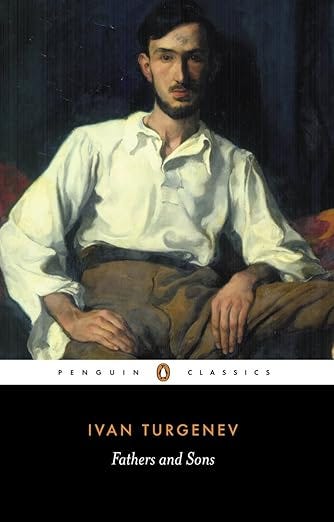
In Turgenev I found a return to more traditional fare, though it was no less profound. Turgenev is focused on generations: how one generation recoils from the next, how another generation spurns the last, and the way these people negotiate—between each other and with themselves—their place in the world. And there is of course a rhyming to it: just as the new generation disappoints Pavel and Nikolay (in their own ways: Nikolay is ever-indulgent, humble, strives to understand even what he finds foolish, while Pavel is stubborn and haughty), they too had disappointed their parents in their ways. And society itself is roiling with social reconsiderations and reforms. Is tradition merely a bunch of sentimental nonsense? Can a life be built with the foundations razed? Is it better to indulge the young and let them riot, or should they be curbed, brought to heel, or perhaps something inbetween? And again questions of understanding each other undergird it all, a theme that prevails through each of these works.
They say when you’re young you tend to sympathize with Arkady and Bazarov (especially Bazarov, the charismatic idol-smashing nihilist), and that when you get older you sympathize more with Nikolay and Pavel. I am, alas, closer in age to the latter than the former, and yet I had compassion and sympathy for them all (though I admit to wanting to smack Bazarov once or twice in the early goings), which I take as a testament not to myself but to Turgenev’s mastery.
Another Life and The House on the Embankment by Yury Trifonov
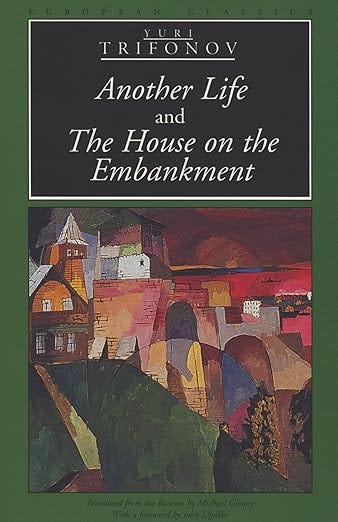
Another Life and The House on the Embankment are a brilliant little novellas, gentle and stirring domestic tales. Sure, the prose is not immaculate (though even this, I concede, may have been purposeful, and of course there’s always the issue of translation), but the construction of the stories is so brilliant, and the psychological depth is profound. Everything is so slippery: relations, memory, words, perceptions. And Trifonov is clearly very well read. The ending of Another Life came as a total shock to me and was primarily so affecting because of Trifonov’s sly use of perspective and time. I’d like to avoid spoilers, but it should suffice to say that the story, told in free indirect discourse, shrinks and opens its aperture at timely moments to conceal what’s to come. Trifonov does a similar thing in House, though there he shifts the perspective between the protagonist Glebov and an unnamed character from his youth, again providing a different flavour to similar events and characters.
Life strikes me, at least from my vantage, as a repudiation of woke claims around “representation”: the work is about, and told from the perspective of, a Russian woman of middle age, a recent widow and mother of a teenager, and I was still totally rapt (that’s not to say it’s not salutary in some meager ways to see representations of oneself in media, particularly at a younger age, but it’s overstated to the extreme and its pursuit is liable to be detrimental to students). I was also frustrated by the book, in that he accomplishes what I’m trying to do in my own writing—capture the sensations of alienation and the ways individuals succeed and more often fail at communicating—so bloody well.
The class dynamics—an obviously important topic in Soviet Russia—in House are fascinating: the striving poor man, Glebov, leaning into academia, is ever envious of the relatively wealthier in the big apartment (which itself is so variegated); the latter are wary of the former (bourgeois striving!), and even perhaps resentful (they feel objectified, look askance at the selfishness); and of course, no bona fides are ever sufficient one way or the other (the professor, an original Communist who fought in the revolution, has plaster busts of philosophers on his bookshelf? Which ones?!), and it is the attack vector of choice when animosities flare in, say, the academe. Glebov is envious of Shulepa, and Glebov is undoubtedly poor, but then, how do others feel about Glebov? It complicates the pat class dynamics we might find in, e.g., Bong Joon-Ho’s work.
All of these books are speaking to each other (more on this below), and it is one of the most gratifying endeavours, for me, to eavesdrop on the dialogue.
And I enjoy the Russian insult “nonentity.”
Liquidation by Imre Kertész
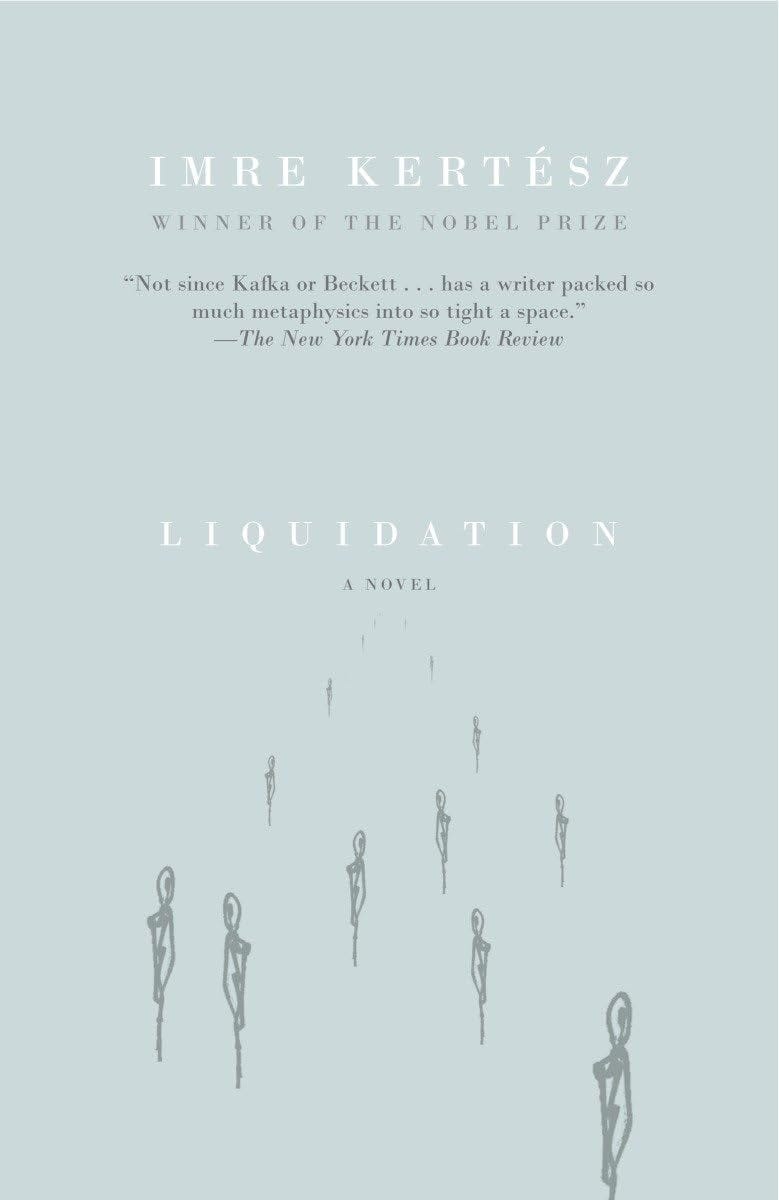
A book about a life recorded (miraculously, prophetically) in a book within that life. Kertesz’ epigraph for the book is from Beckett’s Molloy: “then I went back into the house and wrote, It is midnight. The rain is beating on the windows. It was not midnight. It was not raining.” From before the first page Kertész is confronting you with the fact that this is a work of art, e.g., a contrivance, a simulation of reality, a disturbed and imperfect reflection at most. And if the formal gambit were not sufficiently mind-bending, the prose and philosophical weight bear down on you.
Kertész refers in the work, fortuitously for me, to Dostoevsky, Valéry, and Camus, the latter more than once, albeit unnamed. I feel as though I’ve accessed a sort of literary lineage. It’s hard to call Liquidation a novel… I think I’d refer to both Valéry’s Monsieur Teste and Kertész’s Liquiation as experiments, rather than true novels (whereas Dostoevsky’s Notes from Underground and Camus’ The Outsider are both experiments of this sort and novels, the latter most plainly). Dostoevsky sought to represent a dislocated and profane man; Valéry a man of pure reason; Camus a man who could not lie; and Kertész depicts a man who refuses to leave, or assiduously seeks to live in, the metaphorical world of Auschwitz. It’s the story of a man who refuses a moment’s respite from the desert of Camus’ Myth of Sisyphus. While B., a Holocaust survivor and the primary focus of the book, comes to the same conclusion as Camus in the latter’s essay—the answer to the absurd is to rebel, to live—he kills himself, overwhelmed as he is by Auschwitz, by the brutality and evil of the world, and this is what so disturbs his friends (to paraphrase Kingbitter, one of the two perspectives we have access to in the story, I need to understand his suicide so I know if I can go on living). Kertész is the depressed twin, the shadowed face of Janus, to Camus’ sunny vivacity. Sure, Camus, we must live, we must go on, and you’ve been through much yourself, but have you been through Auschwitz? Have you been to Hell?
But there’s more here and I’ll need to reread it (eventually). As with the experimental Teste, there’s so much at work—and, admittedly, things that don’t work or are at least confounding—that more than one reading will be necessary.
A small taste, from the voice (or writing, more properly) of B. (whose name we are never actually told: his nickname, B. or Bee as it’s represented in the text, derives from the first letter of the tattoo on his thigh, etched into him when he was born in the infirmary at Auschwitz):
My imagination was inadequate, my means were inadequate, and it is no consolation that others too have failed to find the means… I do at least know, however, that one’s sole means is, at one and the same time, one’s sole possession: one’s life.
Mrs. Dalloway by Virginia Woolf

A breath of fresh air after some dour reading! Mrs. Dalloway is vivacious, dense, utterly gorgeous and delectable both imagistically and sonically. Woolf writes one transcendent metaphor after another while constantly changing perspectives so very smoothly as the characters amble and traipse around London in anticipation of Clarissa’s party. Of course, the subject matter is also difficult: death, depression, growing older, and the acceptance or rejection of the aforementioned. And yet reading it I felt so very alive, so bright.
This is also the only originally English work on my list, and it has a noticably different sound: the prose is nearly musical. It has rhythm and euphony, to a far greater extent than all the aforementioned works. Much of this is because Woolf is a master, but I do think some of this at least has to do with her being an English speaker, and British, too.
Of course, at some point I need to get serious about my own writing and scribble more diligently, but I feel, through especially my recent readings, that I’m still barely scratching the surface of possibility. I need to read more.
This brings to mind George Steiner’s observation: “We come after. We know now that a man can read Goethe or Rilke in the evening, that he can play Bach and Schubert, and go to his day’s work at Auschwitz in the morning. To say that he has read them without understanding or that his ear is gross, is cant. In what way does this knowledge bear on literature and society, on the hope, grown almost axiomatic from the time of Plato to that of Matthew Arnold, that culture is a humanizing force, that the energies of spirit are transferable to those of conduct?”